Ganesh Chaturthi 2026 falls on Monday, 14 September 2026, and Anant Chaturdashi visarjan on Friday, 25 September 2026. Between those two dates sit the busiest eleven days in the Indian events calendar – and the two moments that everyone films, the Agman (arrival) and the Visarjan (immersion) procession, are lit completely differently. This guide is a practical booking checklist: what special effects and stage lights actually work for Bappa’s welcome and farewell, what to skip, what the police now restrict, and how to survive a Mumbai September downpour without blowing a fuse.
Agman vs Visarjan: Two Completely Different Lighting Jobs
Most mandals book one lighting package for the whole festival and then wonder why the visarjan reel looks flat. The two events have opposite requirements.
| Factor | Agman (arrival) | Visarjan (immersion procession) |
|---|---|---|
| Time of day | Usually morning to afternoon – bright ambient light | Late afternoon into night – full darkness |
| Movement | Short route or a fixed welcome point | Long moving route, hours on the road |
| Power source | Mains or a small DG set | Battery bank, inverter or trolley-mounted DG |
| Star effect | Cold spark fountains and confetti at the welcome moment | Beams, wash and haze along the whole route |
| Biggest risk | Effects lost in daylight | Rain, water on cables, crowd contact |
| What decides the look | The one arrival cue | Sustained runtime and battery capacity |
Plan them as two separate kits with some shared gear, and both look better.
Part 1: The Bappa Agman Kit – Lighting the Arrival
Agman happens in daylight or early evening for most mandals, which kills half the effects people book. Daylight overpowers coloured light. So the arrival kit has to rely on contrast effects – things that are bright white, physical, or produce visible mass – not on colour wash.
What genuinely works in daylight
- Cold spark fountains. The one effect that reads perfectly on camera even at 2 pm. The classic Agman cue is two machines flanking the entry point, fired as the murti crosses the threshold. A Sparkular Mini V2 400W suits a narrow gully or a society gate; a 650W Sparkular V2 gives you the height for an open ground or a large pandal entrance.
- Confetti and gold streamers. Physical, weightless, photographs beautifully against daylight. Use metallic gold or saffron for the Bappa theme.
- CO2 jets. A 3000W CO2 liquid jet with RGB LED throws a dense white plume that is visible in full daylight – and unlike fog, it disperses in seconds, so it does not blind the crowd or the dhol pathak behind it.
- Bubble machines. Underrated for a daytime welcome and hugely popular with children in the procession. A dual-jet bubble and fog machine does both jobs across the ten days.
- Rotating spark effects. A double-head spinning sparkler either side of the murti creates a moving halo that looks intentional rather than decorative.
What to skip during a daytime Agman
Beam moving heads, lasers, colour wash and thin haze are all wasted before sundown. Save the budget and deploy them on the pandal in the evening instead. If your Agman runs into dusk, the crossover point is roughly 45 minutes before sunset – that is when beams start to bite.
Part 2: The Ten Days – Pandal and Mandap Lighting
Between Chaturthi and visarjan, the job changes again: your lighting has to look good for hours, every night, for thousands of darshan photographs, while drawing power you can afford.
Face light comes first
The most common mistake in mandal lighting is drowning the murti in colour. Bappa’s face needs clean, warm, front-facing light – everything else is background. Start with warm white LED par lights or a 200W indoor LED PAR at roughly 45 degrees from either side of the murti, then build colour behind and around it. Every good darshan photo in Lalbaug is built on this principle.
The rest of the pandal rig
- Colour wash on the backdrop: 180W RGB par cans or 12-eye flat par lights for saffron, gold and deep red tones.
- Outdoor and open-pandal positions: use IP-rated fixtures such as the 54x3W waterproof RGB LED par. September in Maharashtra is still monsoon – indoor-rated par cans in an open pandal will not survive the season.
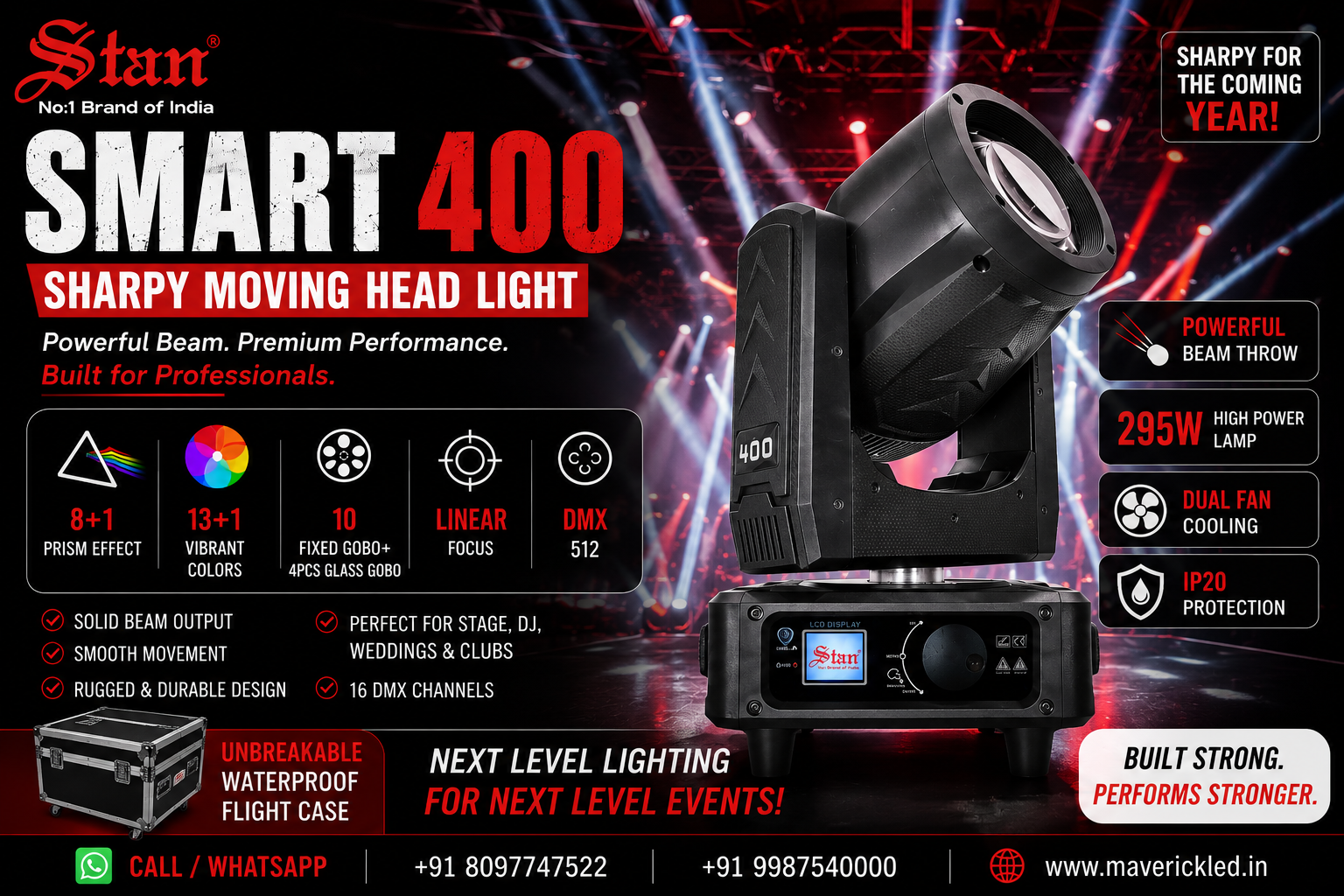
- Beams for the sky and the aarti moment: a pair of 230W 10R beam moving heads for a mid-size mandal, or 350W 20R Sharpy beams and the Stan Monster 650 380W for a big-ground mandal that wants beams visible across the neighbourhood.
- Gobo and texture: a 380W beam-spot-wash 3-in-1 can project a Ganesh gobo, a mandal logo or a sponsor name onto the backdrop – one fixture doing three jobs.
- Decorative layer: glitter curtain string lights and RGBIC music-sync firework lights for the entrance arch, side panels and queue barricades – cheap, low-power, high visual return.
- Haze, not fog: for a pandal, a light haze is what makes beams visible. Heavy fog in an enclosed pandal with a devotee queue is a bad idea – it reduces visibility, triggers complaints and can panic a crowd. Keep fog for open grounds and cue it in short bursts.
Aarti cues worth programming
Morning and evening aarti are your two guaranteed daily audiences. Programme a simple DMX cue: wash lifts to full warm, beams open into a fan, haze thins, and a single cold spark burst lands on the final line. Ten seconds of effect, twice a day, and the mandal’s Instagram takes care of itself.
Part 3: The Visarjan Kit – Lighting a Moving Procession
Visarjan is the hardest lighting job of the year: a moving stage, no fixed power, unpredictable rain, a dense crowd within touching distance, and a route that can take eight to twenty hours. Here is what to build.
On the truck or trolley
- Front-facing light on the murti. Same rule as the pandal – warm white face light first. Nothing ruins a visarjan photograph faster than a murti lit only in green from behind.
- Wash and colour on the rath body using par cans on a low-height truss or clamped to the frame.
- Beam moving heads, angled upward. The Stan Tabahi V2 300W and Stan Atomic 450 380W are procession favourites because they punch through streetlight glare. Point them up and out, never into the crowd or at oncoming traffic.
- Cold spark fountains for the big moments – the start of the route, crossing the main junction, and the final approach to the immersion point. Because they contain no gunpowder and produce no fallout, they are accepted at many locations where conventional firecrackers are restricted. Read our complete cold pyro safety guide before you fire one in a crowd.
- CO2 jets for a clean blast that clears instantly – safer than fog on a moving vehicle in traffic.
- Portable flood lighting for the crew. A 100W rechargeable IP66 flood light on the trolley is the unglamorous item that saves you when something needs fixing at 2 am on the road.
- Wireless control. A wireless remote power switch kit lets one person kill or restart a circuit from the ground without climbing onto a moving rath.
The rule that catches mandals out: lasers and beams in processions
This is the section to read twice. Police in Pune banned laser beams during Ganesh immersion processions after doctors reported eye injuries and partial vision loss among participants, and Pimpri-Chinchwad police have penalised mandals for using banned laser and beam lights during immersion. Similar restrictions and advisories have appeared in other Maharashtra cities.
What this means for your booking:
- Do not assume last year’s permission carries over. Check the current-year notification from your local police commissionerate before finalising the rig.
- The hazard is a laser or a narrow beam aimed at people at close range. Beams angled upward into open sky are a different proposition from a laser scanning a crowd at head height – but where a blanket restriction exists, it applies regardless.
- Build the procession look on wash, par cans, cold sparks, CO2 and upward-angled beams. That way a last-minute restriction on lasers does not gut your entire design.
- Get the mandal’s written permission conditions in the hands of whoever is operating the console. The operator, not the committee, is the person standing next to the fixture.
Part 4: Power, Rain and Safety – The Part Nobody Books For
Ganeshotsav falls in the tail of the monsoon. Wet roads, wet cables and a few hundred amps of stage lighting is the genuine risk at visarjan – far more than any effect machine.
- Calculate your load before you hire the DG. Add up every fixture’s wattage, add 30% headroom, and size the generator to that. Beam moving heads and fog machines draw hard on startup.
- Use an ELCB or RCD on every distribution board and earth the truck frame properly. This is the single most important safety item on a monsoon procession.
- Keep every connection off the ground. Tie cables up along the frame; never let a joint sit in a puddle on the trolley bed.
- Cover the fixtures. Use IP-rated units outdoors where you can, and rain hoods or a simple tarpaulin canopy over the truss where you cannot.
- Check overhead clearance for the whole route. Low-hanging power lines have caused fatal accidents at visarjan processions. Measure your tallest fixture, including a raised beam head, and walk the route in advance.
- Secure the rig for movement. A par can that shakes loose over a pothole and falls into a crowd is a serious injury. Safety-bond every fixture; do not rely on the clamp alone.
- Keep spark machines out of reach. Barricade them or mount them high enough that no one in the crowd can touch a hot nozzle. Maintain clearance from decorations, cloth canopies and paper decor.
- Carry a fire extinguisher and spare fuses on the trolley. And spare DMX cables – a dead DMX line is the most common failure on a long route.
- Respect the timings. Noise restrictions, silence zones near hospitals and schools, and night-time cut-offs apply to sound systems, and lighting or effect conditions are often attached to the same procession permission. Keep the paperwork with the procession.
- Assign one sober, trained operator per effect machine who stays with it for the whole route. Never hand a spark machine remote to a member of the public.
Part 5: Three Ready-Made Kits by Mandal Size
Society or housing-complex Ganpati
Small murti, indoor or covered hall, short visarjan route. Book: 4–6 warm white and RGB par cans, one mini cold spark machine or a pair for the Agman, a 400W RGB LED fog machine for evening cultural programmes, bubble machine for the kids, and glitter curtain lights on the entrance. Runs off a normal domestic supply with a proper board.
Gully or mid-size mandal
Add: 2–4 230W beam moving heads, 8–12 RGB par cans including waterproof units for open positions, a 1200W fog machine, a pair of Sparkular Mini V2 units, a DMX controller and a small DG set. This is the sweet spot where a professional-looking rig is still affordable.
Large public mandal
Add: 350W 20R Sharpy beams or Stan Monster 650 units for sky beams, a 450W moving head with CMY and gobo for projected imagery, 650W Sparkular V2 machines across the stage front, CO2 jets, a 3000W fog machine for the open ground, and a proper truss, DG and cabling plan with a dedicated crew.
Rent or Buy for Ganeshotsav?
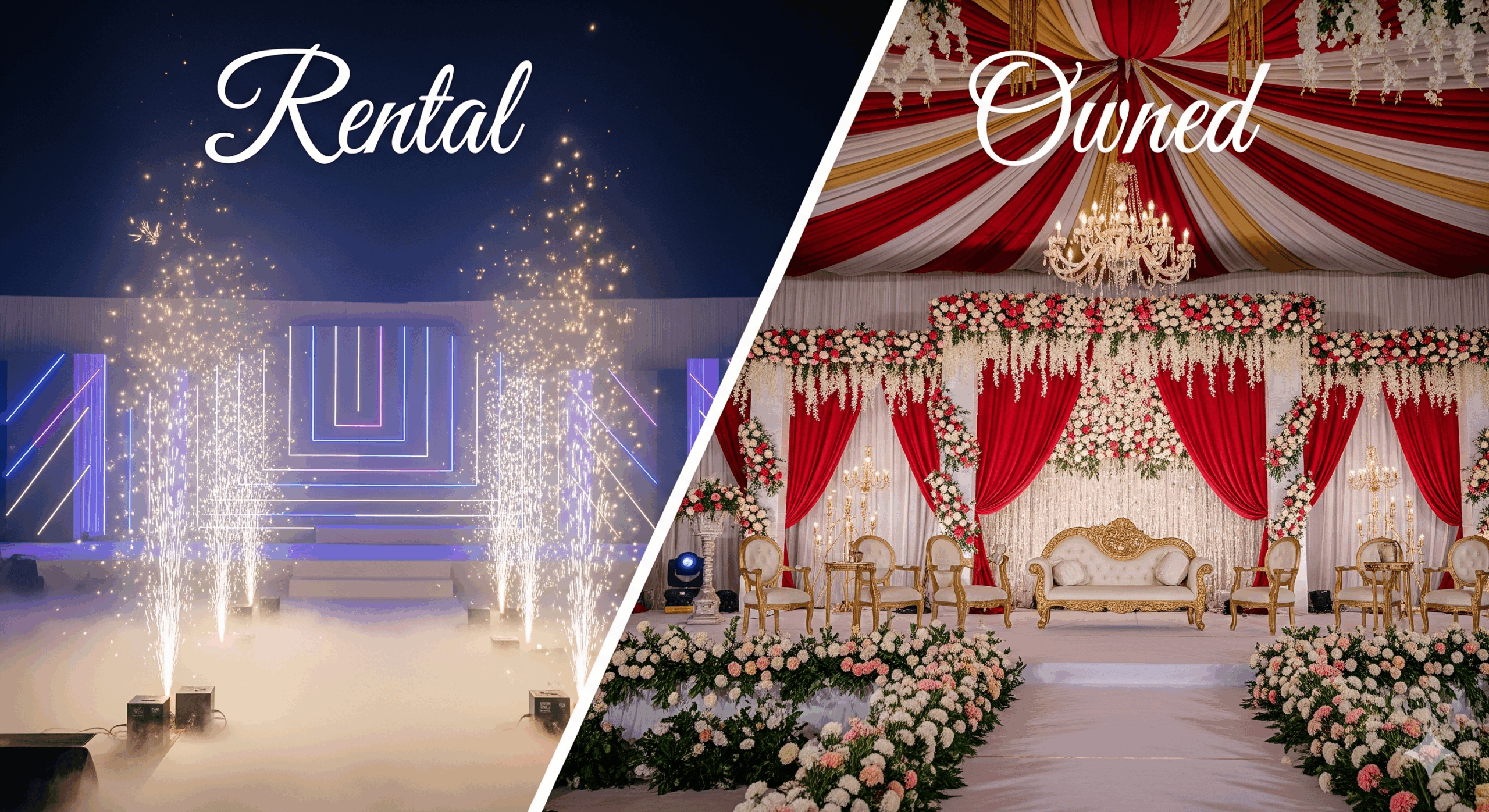
A rough rule: if you use the gear for one festival a year, rent. If your mandal also does Navratri, Diwali, New Year and society functions – or if you are a decorator or DJ serving several mandals – two seasons of rental usually cost more than owning. Effect machines in particular pay for themselves quickly because rental rates on cold pyro are high relative to the machine price. We have covered the maths in detail in Stage Effects Rental vs Purchase in India.
Whichever way you go, book early. The window from late August to Anant Chaturdashi is when every fog machine, beam light and spark machine in Maharashtra is already committed. Mandals that confirm in July and early August get the gear they actually planned for; mandals that call in the second week of September take whatever is left in the godown.
Your Booking Timeline for Ganesh Chaturthi 2026
- July: Finalise the theme and the pandal design. Lighting follows design, not the other way round.
- Early August: Confirm the equipment list and place the order or the rental booking. Apply for police and municipal permissions.
- Late August: Confirm DG capacity, cabling and truss. Order spare powder, fog fluid, CO2 cylinders and DMX cables.
- Week of 7 September: Test every fixture. Programme the aarti and Agman cues. Walk the visarjan route for overhead clearance.
- 14 September – Ganesh Chaturthi: Agman kit deployed, spark cue rehearsed with the dhol pathak so the timing lands.
- 25 September – Anant Chaturdashi: Visarjan rig loaded, checked, safety-bonded and earthed before the procession moves.
Frequently Asked Questions
When is Ganesh Chaturthi 2026 and when is visarjan?
Ganesh Chaturthi 2026 falls on Monday, 14 September 2026. The ten-day visarjan on Anant Chaturdashi is Friday, 25 September 2026. Mandals and households that keep Bappa for 1.5, 3, 5 or 7 days immerse earlier, so plan your effects hire around your own visarjan day, not just the main date.
Which special effects work best for Bappa Agman in daylight?
Cold spark fountains, confetti and streamers, CO2 jets and bubble machines. All four produce visible mass or bright white light, so they read clearly on camera in daylight. Beams, lasers and colour wash are largely wasted before dusk.
Are cold spark machines allowed during Ganpati processions?
Cold spark machines contain no gunpowder, produce no open flame and leave no fallout, which is why they are widely accepted where conventional firecrackers are restricted. Permission still depends on your local police and municipal conditions for that year, and on the venue or route – confirm in writing before the event.
Are laser lights banned in Ganesh visarjan processions?
Restrictions exist in parts of Maharashtra. Pune police have banned laser beams during immersion processions after reports of eye injuries and partial vision loss, and Pimpri-Chinchwad police have penalised mandals for using banned laser and beam lights. Rules vary by city and are re-issued each year, so check your local police commissionerate’s current-year notification before booking laser effects.
How do I power stage lights on a visarjan truck?
Most mandals use a trolley-mounted DG set sized to the total fixture load plus about 30% headroom, or a battery-and-inverter bank for smaller LED-only rigs. Whichever you use, fit an ELCB or RCD, earth the vehicle frame, and keep every connection raised and dry.
Should I use fog or haze in a pandal?
Haze, in most cases. A thin haze makes beams visible without reducing visibility for the darshan queue. Heavy fog in an enclosed pandal with a moving crowd is a safety and comfort problem – save it for open grounds and cue it in short bursts.
How many cold spark machines do I need?
Two flanking the murti is the standard Agman setup. Four to six across a wide stage front gives the wall-of-sparks look for a large mandal. The real limit is clearance and available power, not budget – each machine needs headroom above the set spark height and distance from the crowd and from any cloth or paper decor.
What lighting makes the murti photograph well?
Clean warm white front light on the face at roughly 45 degrees from either side, with colour used only behind and around the murti. Almost every strong darshan photograph follows this rule; colour-only lighting flattens the features and loses the expression.
How early should a mandal book lighting and effects for Ganeshotsav?
Confirm by early August at the latest. Demand across Maharashtra peaks from late August, and by the second week of September most fog machines, beam lights and spark machines are already committed.
Book Your Ganeshotsav Lighting and Effects from Maverick LED, Mumbai
Maverick LED supplies stage lighting, cold spark and Sparkular machines, fog and CO2 machines, bubble machines, par cans, beam moving heads and festival lighting to mandals, decorators, DJs and event companies across India – from our shop in Lohar Chawl, Mumbai.
- Wholesale and dealer pricing on bulk and mandal quantities
- Large ready stock during the Ganeshotsav season, all-India shipping
- Real working videos of the exact unit before you buy
- Genuine spark refill powder, fog fluid and spares on repeat order
- Guidance on load, clearance and rig planning – not just a price list
Call or WhatsApp: +91 80977 47522 / +91 99875 46772
Email: info@maverickled.in
Shop: 56-62, Plot No. 97, Room No. 33, 2nd Floor, Chandabhoy Building, Mangaldas Road, Lohar Chawl, Mumbai – 400002
Browse: Maverick LED online shop | Request a quote | Contact us
Related reading: Ganesh Chaturthi on a Budget | The Complete Guide to Stage Lighting Solutions | Dry Ice Fog Machine vs Regular Fog Machine | CO2 Special Effects Machines for Events | Stage Spotlight & Laser Lighting Solutions
Disclaimer: This article is general planning and safety guidance for mandals and event professionals. It does not replace your local police or municipal permission conditions, your electrician’s load assessment, or the operating instructions supplied with your equipment. Festival dates follow the Hindu calendar – confirm your visarjan day locally. Always verify current-year restrictions on lasers, beams, sound and procession timings with your local authority.