Site Logo

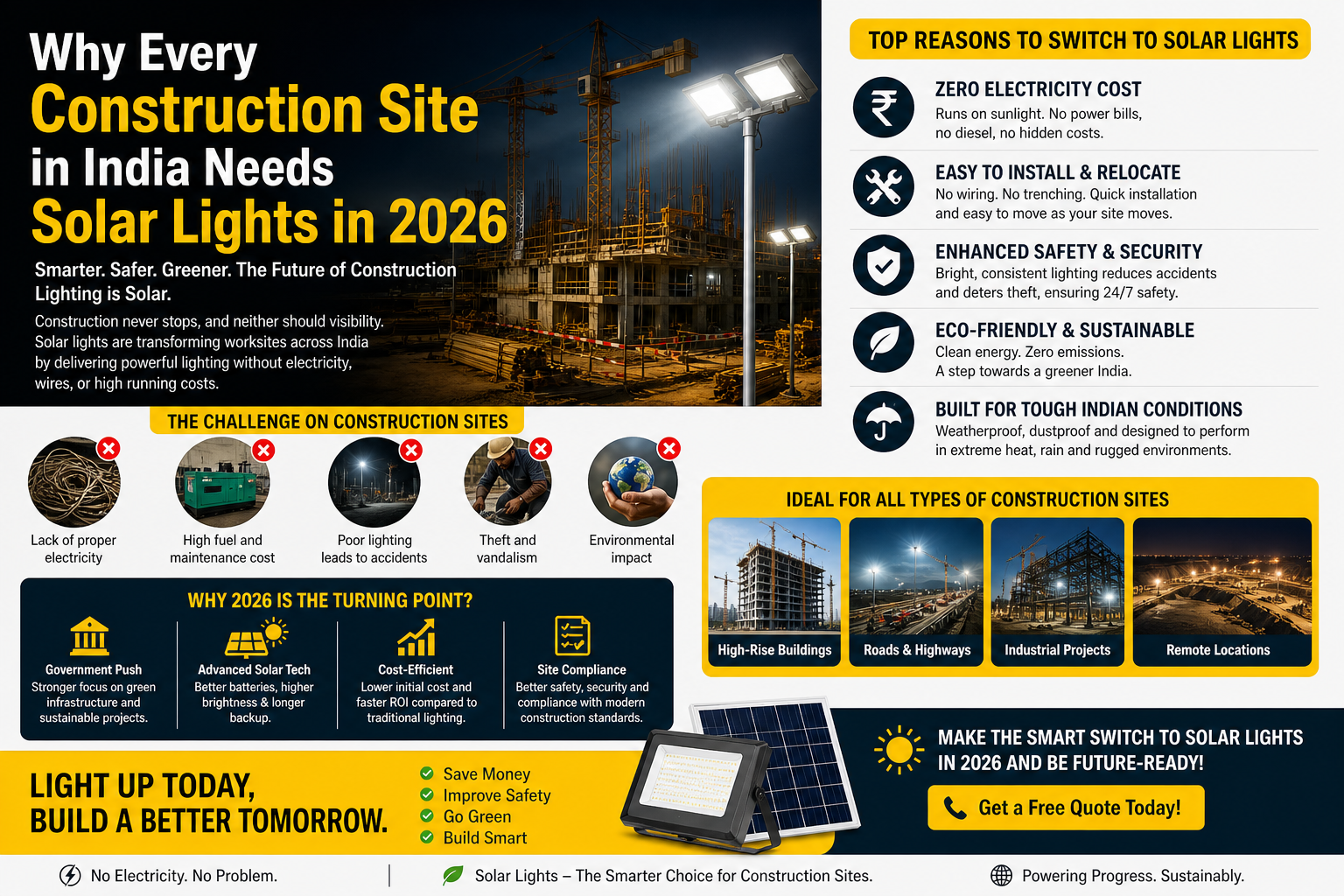
Why Every Construction Site in India Needs Solar Lights in 2026

Published on: April 2026   |   Author: Maverick LED Team   |   Website: www.maverickled.in

Picture this: it’s 7 PM on a highway overpass project outside Pune. The day shift has ended, the night crew is arriving, and the entire site is plunged in darkness except for a handful of diesel generator-powered floodlights — humming loudly, guzzling fuel, and casting patchy shadows across scaffolding and open trenches. It’s a safety risk, a cost drain, and honestly, a problem that India’s booming construction sector has been tolerating for too long.

In 2026, that picture is changing — fast. Solar lights for construction sites are no longer just a “green” choice. They are the smarter, cheaper, and safer choice. Whether you are managing a residential township in Navi Mumbai, an industrial park in Pune, or a road infrastructure project in rural Maharashtra, solar lighting is now the most practical solution available.

Here is exactly why — and what you need to know before making the switch.

1. India’s Construction Boom Demands Smarter Site Lighting

India is in the middle of one of the largest infrastructure expansions in its history. The government’s infrastructure push—highways, metro rail, affordable housing, and smart cities—keeps construction moving day and night. This work happens at thousands of sites across the country.

Traditional lighting solutions — diesel generators, temporary grid connections, halogen floodlights — were designed for a different era. They come with a long list of problems:

  • High fuel costs: Diesel prices in India often change.
    Lighting that runs on generators can add ₹15,000 to ₹50,000+ per month to a site’s operating costs.
  • Grid dependency: Many construction sites, especially in peri-urban and rural areas, don’t have reliable grid access. Running temporary connections takes time, paperwork, and money.
  • Safety hazards: Trailing wires, exposed electrical connections, and open generators are a constant hazard on active construction sites.
  • Carbon obligations: India’s ESG commitments and green building certifications (IGBC, LEED) increasingly require contractors to demonstrate sustainable site practices.

Solar lights for outdoor use — especially solar street lights and solar flood lights — solve all four of these problems in one go.

2. Solar Lights for Construction Sites: Key Benefits in 2026

Zero Grid Dependency

A solar light with battery storage is completely self-contained. Install it in the morning, and it charges all day. By night time, it powers itself — no cables, no connection to the grid, no generator. Solar lights are ideal for remote sites, new plots, and areas without a commissioned grid connection.

Massive Cost Savings Over Project Lifetime

Here’s a real-world comparison that every site manager should see:

FactorDiesel Generator LightSolar Light with Battery
Monthly Fuel Cost₹15,000 – ₹50,000₹0
MaintenanceHigh (engine servicing)Minimal (LED + panel)
Installation Time2–3 days (wiring)2–4 hours
NoiseHigh (generator)Zero
Carbon FootprintHighZero
Usable After ProjectNo (costly to move)Yes (relocatable)

Relocatable & Reusable Asset

Unlike a temporary grid connection or a fixed generator installation, solar lights — particularly pole-mounted solar street lights and portable solar flood lights — can be packed up and reused on your next project. They are a one-time investment that keeps delivering value across multiple sites and years.

Improved Worker Safety

Poor lighting on construction sites is one of the leading contributors to after-dark accidents. Solar LED lights deliver bright, uniform illumination — far better than patchy halogen floodlights. Brighter sites mean safer sites, fewer accidents, and lower liability for contractors and developers.

3. Which Solar Lights Work Best on a Construction Site?

Not all solar lights are built the same. Here is a quick breakdown of the key types and where they are most useful on site:

  • Solar Street Lights (integrated or split): Best for illuminating access roads within the site, main pathways, entry and exit gates, and parking areas. Look for waterproof solar street lights (IP65 or higher) as construction environments are dusty and wet.
  • Solar Flood Lights Outdoor (100W–200W): Ideal for illuminating work areas, construction facades, and large open zones where high-intensity light is needed. A 200W solar flood light outdoor can cover a large radius, making it perfect for tower crane bases and material staging zones.
  • Solar Panel with Battery (standalone systems): For critical areas like site offices, security checkpoints, and welfare facilities, a solar panel with battery system provides reliable, consistent power independent of weather or grid.
  • Solar Lamps & Portable Solar Lights: For individual worker stations, inside partially-constructed buildings, and stairwells, portable solar lamps are lightweight, easy to set up, and safe to use.
Pro Tip from Maverick LED Always choose solar flood lights and solar street lights with an IP65 or IP66 waterproof rating for construction sites. Sites are exposed to rain, dust, cement splash, and humidity — your lights need to handle all of it. Browse our full range at www.maverickled.in.

4. Solar Lighting & Green Building Compliance in India

In 2026, sustainable construction practices are not just good ethics — they are increasingly a contractual and regulatory requirement. Here is why solar lights are directly relevant to compliance:

  • IGBC & LEED certification: Green building certifications under the Indian Green Building Council (IGBC) and LEED India award points for on-site renewable energy use and reduced carbon footprint. Solar lighting during the construction phase contributes directly to these credits.
  • Maharashtra & Urban Local Body requirements: Several municipal corporations and state development authorities in Maharashtra now encourage — and in some cases require — renewable energy use on large construction sites under their sustainability frameworks.
  • ESG reporting for developers: Listed real estate companies and large infrastructure contractors increasingly report their ESG performance. Documenting on-site solar lighting usage contributes positively to scope 2 and scope 3 emissions reduction data.

In short, switching to solar lights on your construction site in 2026 is not just a cost decision — it is a compliance and reputation decision too.

5. How to Choose the Right Solar Lights for Your Site

Selecting the right solar lighting setup for a construction site comes down to five key factors:

  • Lumen output & coverage area: Match the light’s lumen output to the size of the zone you need to illuminate. A 100W–200W solar flood light outdoor is typically sufficient for zones up to 500–1,000 sq. metres.
  • Battery capacity: Look for solar lights with enough battery to provide 10–12 hours of operation on a full day’s charge. Lithium-ion batteries are preferred over lead-acid for their longer lifespan and lighter weight.
  • IP waterproof rating: IP65 minimum for all outdoor construction site applications. IP66 or IP67 is better for sites in high-rainfall or coastal areas like Mumbai.
  • Pole height & mounting flexibility: Solar street lights on construction sites should ideally be on portable or collapsible poles so they can be repositioned as work areas change.
  • Warranty & after-sales support: Ensure your supplier offers at least 2–3 years of product warranty and responsive technical support — not just a product with a good spec sheet.
Maverick LED At Maverick LED (www.maverickled.in), we supply a complete range of solar lights for construction sites — including solar street lights, solar flood lights outdoor (up to 200W), solar panel with battery systems, and portable solar lamps. Our products are built for Indian conditions: IP65-rated, high-efficiency, and backed by reliable after-sales support.

6. Real-World Example: Solar Lights on a Mumbai Construction Site

A mid-size residential project developer in Navi Mumbai recently switched from diesel-generator lighting to solar street lights and solar flood lights across three construction sites in the Mumbai Metropolitan Region.

The results after six months:

  • Monthly lighting cost reduced by 78%: from ₹38,000/month (diesel + maintenance) to approximately ₹8,400/month (amortised cost of solar lights over 3-year life).
  • Zero power outages: after dark, as the solar panel with battery systems continued operating through MSEDCL outages that affected temporary grid connections on the same project.
  • IGBC documentation: the use of solar LED lights on-site contributed to 3 additional IGBC credit points during their green certification process.
  • Improved safety record: reported night-time incident rates dropped by over 60% within the first three months of switching to better-lit solar lighting.

These are the kinds of outcomes that make solar lights for construction sites one of the most sensible investments a project manager can make in 2026.

Conclusion: The Time to Switch is Now

India’s construction industry is scaling up at a pace we have never seen before. The sites are bigger, the timelines are tighter, the compliance requirements are stricter — and the cost of inefficiency is higher. Solar lights are not a future consideration anymore. They are here, they are affordable, and they deliver measurable ROI from day one.

Whether you need solar street lights for site roads, solar flood lights outdoor for work zones, or a complete solar panel with battery system for your site office — the right solar lighting solution exists for your project.

Explore Maverick LED’s full range of solar lights for construction sites at www.maverickled.in — and let’s light up your site the smarter way.

Frequently Asked Questions (FAQ)

Q: What is the best type of solar light for a construction site in India?

A: Solar flood lights outdoor (100W–200W) are the most effective for large work zones, while solar street lights work best for access roads and pathways. For site offices and security posts, a solar panel with battery system provides the most reliable power. All products should have a minimum IP65 waterproof rating for site use.

Q: How long do solar lights last on a construction site?

A: High-quality solar LED lights with lithium-ion batteries typically last 5–7 years with minimal maintenance. The LED components themselves can last 50,000+ hours. Look for products with at least a 2-year warranty from a reliable supplier like Maverick LED.

Q: Can solar lights work during the monsoon season in Mumbai and Maharashtra?

A: Yes. Quality solar lights are designed with IP65 or higher waterproof ratings, meaning they are fully protected from rain and dust. While cloudy days reduce charging efficiency, a well-sized solar panel with battery system will store enough charge to operate through 2–3 consecutive overcast days.

Q: Are solar lights for construction sites expensive upfront?

A: The upfront cost of solar lights is higher than basic halogen floodlights, but far lower than the ongoing operational cost of diesel generators. Most construction site solar light installations recover their investment within 6–18 months through fuel and maintenance savings.

Q: Do solar lights qualify for green building credits in India?

A: Yes. Using solar lights during the construction phase contributes to reduced on-site carbon emissions and can support IGBC and LEED India certification credits related to construction activity pollution and on-site renewable energy use.

Suggested Internal Links for maverickled.in → Solar Street Lights — Product Page → Solar Flood Lights Outdoor (100W / 200W) — Product Page → Solar Panel with Battery Systems — Product Category → Solar Lamps & Portable Solar Lights — Product Page → Contact Us / Get a Quote — Contact Page   Suggested Tags: solar lights, solar street light, solar flood light outdoor, solar panel with battery, solar light for construction site, solar LED light India, solar lamp outdoor, construction site lighting India 2026

Leave a Comment

Your email address will not be published.

Select the fields to be shown. Others will be hidden. Drag and drop to rearrange the order.
  • Image
  • SKU
  • Rating
  • Price
  • Stock
  • Availability
  • Add to cart
  • Description
  • Content
  • Weight
  • Dimensions
  • Additional information
Click outside to hide the comparison bar
Compare